With innovative technology and new automation, the need for cybersecurity technology is at unsurpassed high. As the world advances into technology, most businesses have changed the way they conducted due to the industry disrupting innovation, especially the accounting industry. It is one of the most sensitive industries, which involves the transaction of finances. With the emerging technology called “Blockchain”, it helps the accountancy professionals and organizations to maintain the accountability and security of the financial information. So, What exactly is a blockchain? How blockchain is revolutionizing the accounting system? What major implications will it have on the future of accounting? and How does it benefit the business as a whole?
What exactly is a blockchain?
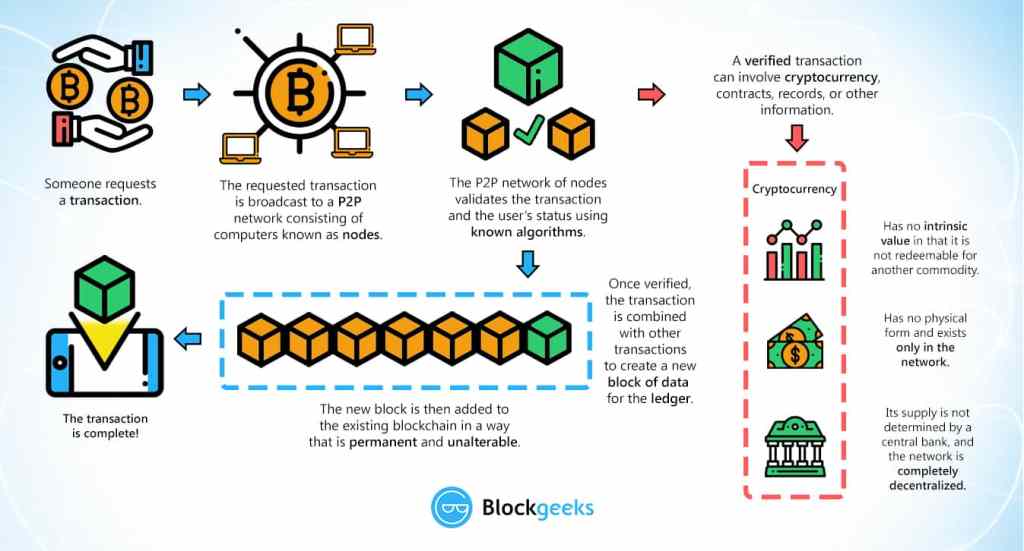
A blockchain is a decentralized, chronological ledger that shared among particular parties in a network protected by cryptography. It is an accounting technology that accountants use to perform the financial transactions every day including recording keeping and auditing. It is decentralized and utilizes peer-to-peer networking innovation, which means the transactions are not controlled by bank or trusted institution.
Blockchain explained video in 2 minutes
The current state of accounting technology
The digital age of accounting system is still in its early stage compared to other industries. It is one of the most sensitive industries due to the reason that it involves the financial transactions as well as it is easily disrupted by the advances of technology. The current financial accounting depends solely on a double entry systems. With this entry system, it tackled the issue of managers knowing regardless of whether they could confide in their own books yet did not solve the problem of money related confirmation for outside parties. Hence, to lighten this issue, most businesses relied on auditors and trusted financial institutions. However, hiring agents is a costly practice and it does not ensure the overall accuracy of financial information.
Due to the fact that the total accuracy is limited, Security Exchange Commissions (SEC) was established to advance full public disclosure, protect investors against deceitful and manipulative exercises in the market, and tracks corporate take over actions; especially in the U.S. On top of that, most businesses implement Enterprise Resource Planing (ERP) to aggregate both the internal and external data and accounting information their businesses. However, the problem with these systems is it could be manipulated and hacked into the financial information.
Example of a fraudulent financial reporting case
One example of fraudulent financial reporting case is WorldCom Scandal case. In this case, WorldCom; now MCI, Inc. is one of the companies that caused $180 billion in losses for investors. These losses emerged from the intentional misinterpretation and management decision to fraudulently manipulate the financial information in which the WorldCom’s internal auditing department got caught by revealing $3.8 billion of fraud. This fraudulent financial reporting massively affects the investors and business itself. That is why the SEC was created to enact and fine the business who fraudulently manipulate the financial information. Also, the ERP was utilized to monitor these problems. However, these systems still have its limitation in controlling these issues.
That is why Blockchain was created to help maintain the accountability and security of financial transactions and information that protected by cryptography.
How blockchain may enhance today’s and future accounting practice?
Blockchain itself can be viewed as an innovation dependent on accountancy as it may represent the next step for accounting. It records and stores various financial transactions including cash flow and reconciling accounts. Businesses can compose their transactions legitimately into a joint register, making inter-locking systems of enduring accounting records instead of keeping separate records dependent on transactions receipts. It is practically impossible to misrepresent or destroy them to hide the activity since all entries are distributed and cryptographically fixed. Hence, It is such a valuable opportunity for accountants to streamline their processes and reviews, while guaranteeing that the records are accurate and reliable.
Four big accounting firms including Deloitte, Ernst & Young, PwC, and KPMG, are now investing vigorously in blockchain technology in which Deloitte is having 30 blockchain models and running. By investing in blockchain innovation, these firms can lessen the opportunities for error that can emerge while reconciling complex and divergent data from numerous sources in which it results in improving efficiency and cost reducing.
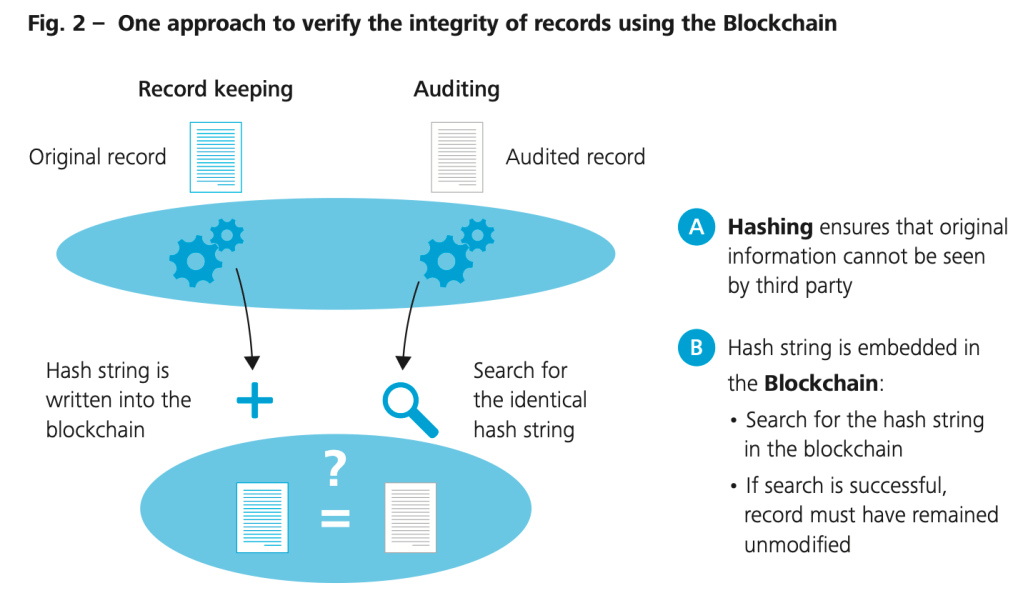
It is easily conceivable to prove integrity of electronic files by utilizing the blockchain. One methodology is to generate a hash string of the file to ensure the original information cannot be seen by the third party. The hash string represents the digital fingerprint of that file and it is immutable. At any time, to prove integrity of that file, fingerprint will be generated and compared in with the fingerprint stored in the blockchain. In the event that the fingerprints are identical, the file stayed unchanged since previous writing the hash to the blockchain.
Blockchain accounting explained video in 3 minutes
By watching this video, you will get an overall understanding of how every transaction is recorded, sent, and received independently between each individual. Within the use of blockchain technology, it revolutionizes both the way companies invoice one another and the way payment are done along the supply chain right to the end consumer.
Conclusion
The blockchain innovation has the influence to shape the development of today’s and future accounting. The potential of distributed ledger innovation or blockchain to the accounting industry changes the way that accountant and businesses conducted the financial transactions. It helps to lessen the fraud and related human error during the process while they can secure the financial information. Last but not least, it helps the investors to get the accurate and trustful financial information, both internal and external inventory information, which benefits the businesses as whole both.
References:
Andersen, N. (2016). Blockchain Technology A game-changer in accounting? Deloitte. Retrieved from Deloitte: https://www2.deloitte.com/content/dam/Deloitte/de/Documents/Innovation/Blockchain_A%20game-changer%20in%20accounting.pdf
Arnold, A. (2018). Blockchain Is Not A Threat To Accounting, It’s An Opportunity. Retrieved from Forbes: https://www.forbes.com/sites/andrewarnold/2018/08/28/blockchain-is-not-a-threat-to-accounting-its-an-opportunity/#77946f8768d0
Corporative Systems. (2019). Blockchain Technology and The Future of Accounting. Retrieved from https://coopsys.com/blockchain-technology-accounting/
Chen, J. (2019). Security and Exchange Commission (SEC). Retrieved from Investopedia: https://www.investopedia.com/terms/s/sec.asp
Institute for the Future. (2016). Understand the Blockchain in Two Minutes. Retrieved from https://www.youtube.com/watch?v=r43LhSUUGTQ&t=14s
Ovenden, J. (2019). Will Blockchain Render Accountants Irrelevant? Retrieved from The Innovation Enterprise: https://channels.theinnovationenterprise.com/articles/will-blockchain-render-accountants-irrelevant
The Accounting Degree Review. (2020). The 10 Worst Corporation Accounting Scandals of All Time. Retrieved from https://www.accounting-degree.org/scandals/
The Accounting Blockchain. (2018). The Accounting Blockchain. Retrieved from https://www.youtube.com/watch?v=t-BHjde1-4M&t=3s
 Posenghak Tan's MIS304 Site